Is your GRC operating model ready for what’s next?
A practical guide to evaluating GRC platform scalability for finance, risk, audit, and technology leaders
At-a-glance
The problem
Governance, risk, and compliance (GRC) programs are becoming more interconnected, more visible, and more operationally complex. Many organizations implemented GRC technology to support internal audit, SOX, or compliance workflows. Those use cases remain important, but governance requirements now extend across risk, controls, audit, reporting, ESG, and operational governance.
When those activities are managed through separate tools, spreadsheets, email threads, shared folders, and manual handoffs, teams often spend more time reconciling information than improving risk visibility, control effectiveness, and reporting confidence.
The impact
This shift is already affecting organizations in meaningful ways. Audit teams are reducing manual evidence collection, finance teams are improving reporting consistency, risk and compliance teams are gaining more real-time visibility, and organizations are reducing dependency on spreadsheets and offline processes.
The opportunity
Organizations reevaluating GRC platforms have an opportunity to design a connected governance operating model, and one that improves data consistency, workflow orchestration, evidence management, reporting traceability, and cross-functional collaboration.
Clearsulting POV
The future of GRC is a connected governance platform instead of standalone workflow management. The question is no longer, ‘Which tool can manage the workflow?’ It is:
- Can governance data connect across functions?
- Can reporting and compliance operate together?
- Will the platform scale as governance requirements evolve?
- Does the platform reduce fragmentation or create more of it over time?
Rather than functioning as a standalone GRC point solution, the Workiva platform enables organizations to unify governance and reporting activities across the enterprise through assured and connected reporting, enterprise-grade integrations, granular auditability, scalable workflow automation, and purpose-built agentic-AI capabilities.
Clearsulting helps clients translate the Workiva platform capabilities into operating-model outcomes by aligning process design, data ownership, workflow governance, evidence strategy, integration, migration, adoption, and value realization.
——-
Why GRC modernization matters now
Large enterprises are under increasing pressure to strengthen governance, improve risk visibility, and modernize compliance operations across increasingly complex control environments. Two key trends are accelerating this shift:
- Stakeholder expectations & expanding complexity: Boards, regulators, external auditors, and executive leadership teams increasingly expect stronger governance, greater transparency, improved auditability, and faster issue remediation to make informed decisions. At the same time, governance work is no longer isolated within internal audit or SOX. Therefore, organizations are often managing overlapping requirements and creating duplicate reporting logic, dashboards, and inconsistent metrics. When those activities are disconnected, teams can spend more time reconciling information than acting on it.
- AI & automation expectations: AI and automation are also changing expectations. Leaders increasingly want teams to automate evidence collection, identify emerging risks, and improve decision-making. However, those outcomes largely depend on connected, controlled, and trusted data foundations.

Where fragmentation creates risk and cost
In Clearsulting’s experience, the biggest GRC pain points are rarely limited to one workflow. They often appear in the handoffs between teams, tools, data structures, and reporting outputs.
Many organizations have accumulated separate tools for:
- audit,
- controls,
- reporting,
- ESG,
- compliance,
- and risk management.
A control change may be updated in one workflow, while related risk documentation, audit committee materials, ESG control documentation, and external reporting support must still be updated manually. ESG metrics might be collected in spreadsheets, reviewed over email, stored in shared folders, and the re-entered into disclosure support. Issue remediation may be tracked in one system while leadership reporting is recreated separately in presentations or dashboards.
These breakdowns rarely appear as one large failure point, but instead show up as recurring reconciliation work, duplicate data entry, version-control risk, delayed reporting cycles, inconsistent metrics, and limited confidence in what leaders are seeing. Over time, this creates disconnected governance processes that are more expensive to operate and harder to scale.
This is one of the areas where the Workiva platform’s connected reporting model significantly changes the operating model.

AuditBolt research shows that evidence collection and follow-up activities can consume 30–35% of total audit hours, making automation one of the most impactful opportunities for improving efficiency and audit readiness (Source: AuditBolt Internal Audit Automation Analysis). A connected governance platform can reduce the operational seams where data is re-entered, re-approved, re-explained, and reconciled across functions.
The Workiva platform’s connectors and chains framework enable organizations to automate data collection and workflow orchestration across enterprise systems, shifting governance operations from “collect-and-chase” toward “monitor-and-exception.”
Capabilities to prioritize in a connected governance model
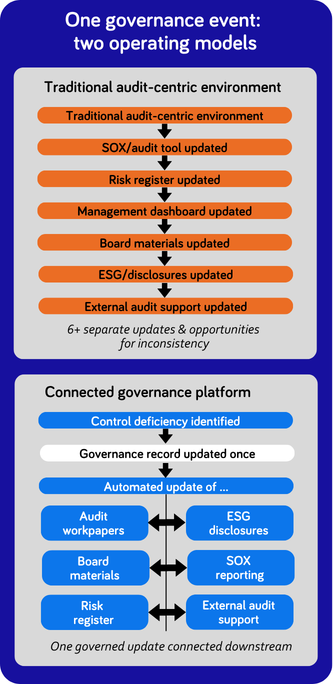
Organizations evaluating GRC modernization determine immediate workflow functionality and assess whether the broader operating model can support the governance, reporting, and assurance needs the business will have over time. Both the Workiva platform and traditional GRC platforms offer strong capabilities for governance, risk, and compliance programs.
Where traditional GRC platforms typically excel
These tools are often well-positioned when organizations prioritize:
- rapid audit modernization,
- strong internal audit workflows,
- intuitive user experiences,
- and straightforward SOX management capabilities.
Where Workiva differentiates
The Workiva platform’s differentiation is broader and more platform-oriented. Rather than functioning as a standalone audit tool, Workiva enables organizations to unify governance, risk, controls, reporting, and ESG activities within a connected governance platform.
Key differentiators include connected reporting, enterprise-grade automation, granular auditability, sustainability and financial reporting integration, scalable cross-functional collaboration, and agentic AI capabilities. This reduces fragmentation while enabling scalability and operational sustainability over time.
As governance requirements expand beyond audit and controls management, organizations increasingly prioritize platforms that can support reporting, compliance, ESG, and assurance activities within a connected governance platform.
How Workiva fits into the connected governance conversation
For organizations evaluating Workiva as part of their GRC modernization strategy, the platform can support a more connected governance model by bringing reporting, risk, controls, compliance, ESG, and assurance activities into a unified environment.
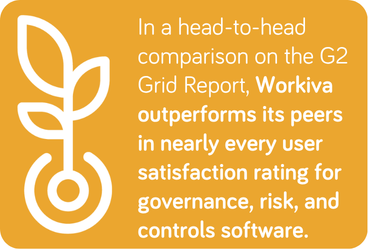
Workiva’s connected reporting model allows teams to link data once and reuse it across reports, workflows, dashboards, and presentations. This can help reduce manual reconciliation, spreadsheet dependency, version-control risk, and duplicated reporting effort.
From an implementation perspective, this matters because reporting risk often emerges at the handoffs — when data is exported, reformatted, re-approved, and re-entered across multiple tools. A connected platform can help create a more consistent line of sight from source data to final report.
Workiva also supports governance activities through capabilities such as enterprise integrations, workflow automation, permissions, revision history, linked data, audit trails, dashboards, and AI-enabled functionality. For organizations expanding beyond audit and controls management into ESG reporting, financial reporting, enterprise risk, sustainability, and integrated assurance, those capabilities can help support a more scalable governance operating model.
The path forward
Organizations evaluating GRC modernization should look beyond immediate workflow functionality and consider broader operational sustainability.
Key evaluation questions should include:
- Can the platform support connected reporting and governance?
- Can governance data scale across functions?
- Will the platform reduce or increase fragmentation over time?
- Can automation meaningfully reduce operational effort?
- Does the architecture support future reporting and regulatory requirements?
The organizations that modernize successfully will not simply replace one workflow tool with another. Instead, they will build connected governance capabilities that support increasingly complex reporting, risk, compliance, ESG, and assurance requirements with less manual effort and greater confidence.
Why Clearsulting
Clearsulting helps organizations assess current-state fragmentation, evaluate platform fit, define a connected governance roadmap, and build a practical path from today’s GRC environment to a scalable, connected governance operating model.
Continuing to solve governance challenges through disconnected tools will increase operational complexity over time. Organizations that invest in connected governance platforms early are often better positioned to scale governance and reporting requirements with less disruption.
Move from GRC workarounds to governance confidence
Clearsulting can help your organization assess current-state complexity, identify where fragmentation is creating risk or cost, and define a practical roadmap for a more connected governance operating model. Start the conversation with Clearsulting today.