Fixing the front door: Why procurement intake keeps failing (and how to get it right)
Intake and orchestration platforms can now route, review, and resolve requests across the enterprise. The organizations capturing that value design the operating model alongside the technology.
—–
Your organization has invested in procurement technology. You’ve built the workflows, established the approval processes, and given employees a place to submit purchasing requests. So why are people still going around it?
Software purchases happen outside procurement. Supplier requests get buried in email. Approvals bounce between legal, IT, security, and finance. And by the time procurement gets involved, the decision has often already been made.
The problem isn’t necessarily the technology. It’s what happens after someone walks through the front door.
Procurement intake has become one of the most active areas of innovation in source-to-pay. Platforms, such as Coupa and Tonkean, are advancing how organizations capture requests, coordinate approvals, and connect purchasing decisions across systems. AI is creating even more possibilities.
But here’s where we think organizations need to be careful: The platforms are ready. Most organizations are not.
Intelligent orchestration can make procurement faster, easier, and more connected, but if the processes, policies, and decision rights behind the technology haven’t been designed properly, organizations risk automating the same problems they’ve been trying to solve.
Why procurement intake stalls: Four conditions that send requesters around the front door
When employees bypass procurement, it’s easy to assume they simply aren’t following the process. But, often, the process itself is what’s getting in their way.
Four common challenges help explain why.
- Traditional P2P wasn’t designed for every type of purchase. Catalog and purchase order-driven buying works well for straightforward transactions. But purchases involving SaaS, professional services, data, and AI tools often require input from legal, IT, security, and finance. When the process doesn’t reflect how the business actually buys, employees find another way.
- Ticketing tools track status, not decisions. Platforms such as ServiceNow or Jira can show where a request sits, but without the right integrations and decision logic, they may not determine whether a supplier is approved, budget is available, or a policy applies. Those decisions move into emails and side conversations, leaving an incomplete record.
- The ERP is a system of record, not a system of engagement. ERP systems are essential for financial transactions, but they aren’t necessarily intuitive starting points for employees navigating complex purchases. If submitting a request is too difficult, less controlled channels, including corporate cards, become more attractive.
- Policy lives in people’s heads. This may be the most overlooked problem of all. Approval thresholds, risk tiers, and purchasing policies may exist, but they’re often buried in documents or interpreted differently across teams. When the process depends on knowing whom to ask, delays and inconsistent decisions are inevitable.
Individually, these issues may look like process inefficiencies, but, together, they create a much bigger business problem. Spend surfaces after it is committed, reviews run in sequence because no one designed them to run in parallel, and procurement loses the opportunity to influence decisions before they’re made.
That’s why fixing intake isn’t just about making requests and more about making the entire purchasing process work better.
What intelligent orchestration changes
The good news is that organizations have more ways than ever to address these challenges. Think about an employee requesting a new software subscription. Traditionally, that request might move from procurement to IT, then to security, legal, and finance. Each team needs different information, and every handoff creates another opportunity for delay.
With intelligent orchestration, the request can be classified upfront, the appropriate reviews triggered in parallel, and relevant supplier, contract, and budget information connected across systems. Routine steps can be automated while higher-risk decisions remain with the people responsible for making them.
The goal isn’t simply to get employees through the front door faster. It’s to remove the complexity waiting on the other side. Done well, orchestration helps procurement move from gatekeeper to service orchestrator. Policies become part of the workflow rather than instructions employees must interpret. Purchasing decisions become visible earlier, giving procurement greater influence over spend, suppliers, and risk.
And the impact can be significant. Experience has shown that requisition cycle-times can be reduced by 50–70% through improvements such as parallel reviews and automated routing.
But technology selection matters.
For organizations already invested in Coupa, the first step should be understanding what their existing environment can support and where additional capabilities may be needed. Tonkean and other orchestration technologies offer ways to coordinate workflows across functions and systems, but the right approach depends on the organization’s process complexity, integrations, and existing investments.
Keep in mind: organizations don’t always need another front door, and sometimes they need to make the one they already have work better.
That’s where procurement expertise and technology knowledge need to come together. At Clearsulting, we approach these decisions by understanding how the business operates first, then determining how solutions such as Coupa and Tonkean can support a more connected, efficient purchasing experience.
AI can open more doors, but who should hold the keys?
AI adds another layer to this conversation, particularly when it comes to deciding which purchasing decisions should be automated and which should stay with people.
Intake is where purchasing intent, context, and policy come together, making it a natural starting point for AI-enabled workflows.
AI agents can help classify requests, assemble supporting information, identify the appropriate approval path, and validate routine requirements, but giving technology more responsibility also raises an important question: how much decision-making authority should an organization actually give it?
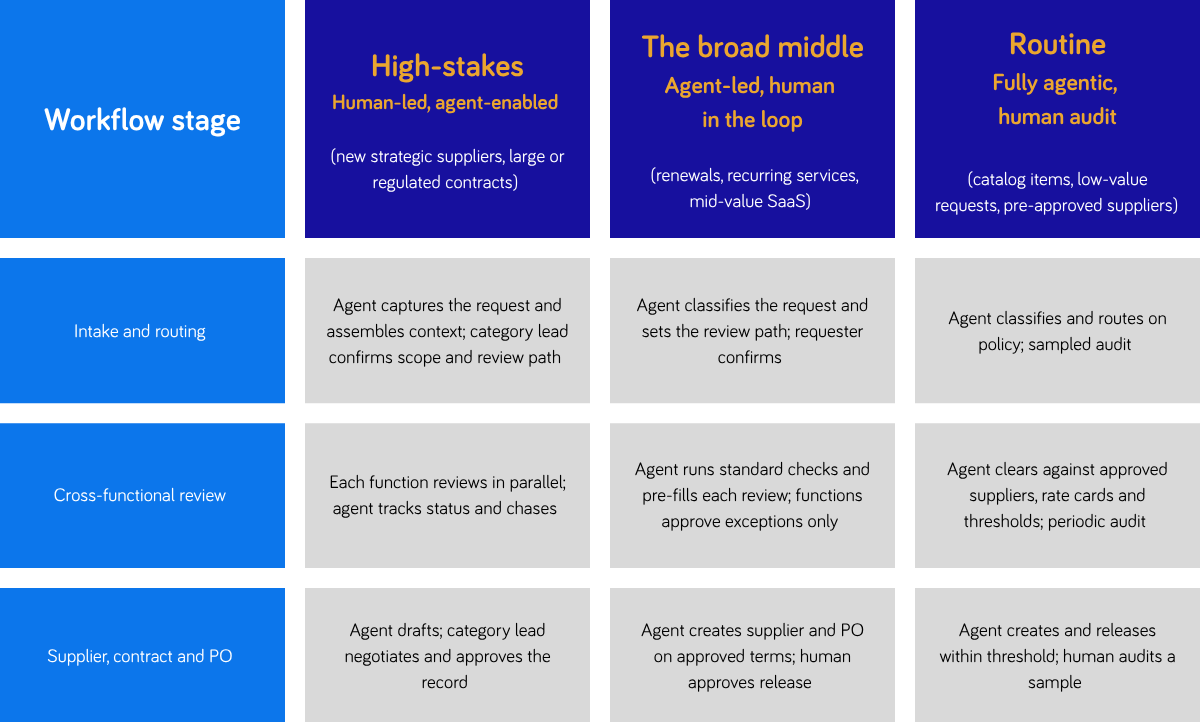
Not every purchasing decision carries the same level of risk. Ordering from an approved supplier shouldn’t require the same oversight as onboarding a new strategic vendor or signing a major technology contract. And that’s where governance becomes critical.
Organizations need to establish which decisions can be automated, which require human approval, when exceptions should be escalated, and what evidence must be retained.
Exhibit: Matching automation to purchasing risk.
Illustrative example. Actual decision rights and automation levels should be determined by organizational policy, risk, and platform capabilities.
A better front door starts with a better design
Here’s the part that doesn’t get enough attention in conversation about procurement technology: a faster workflow isn’t always the better workflow.
If an organization has five unnecessary approvals today, automating those approvals isn’t going to fix the problem – it’ll just move a poorly designed process through the system at a faster speed. And if procurement, legal, IT, and finance haven’t agreed on who owns which decisions, a new platform isn’t going to resolve that disagreement for them.
This is why we believe operating model design deserves just as much attention as the technology itself. Before investing in another solution, I’d encourage procurement leaders to ask themselves:
- Do we understand the different types of requests entering procurement and the risks associated with each?
- Have our cross-functional teams agreed on who owns approvals, exceptions, and purchasing decisions?
- Are we getting the most from our existing technology before introducing another layer?
- Do we know which decisions AI can make and which require human oversight?
- Can we measure whether our process is actually improving cycle time, spend visibility, and the employee experience?
If leaders can’t answer these questions, they’re probably not ready to automate the process.
The front door is only the beginning
Consider one final question: If an employee needs to purchase a new software solution tomorrow, could your organization tell them exactly where to start, what happens next, and how long it should take? If the answer isn’t clear, that’s a good indication the front door needs attention.
At Clearsulting, we look at the full picture: how employees buy, where decisions get stuck, and whether the technology is actually supporting the process. That’s how we help organizations identify what needs to change and where orchestration can deliver value. Whether that means optimizing an existing Coupa environment or evaluating intelligent orchestration capabilities, the focus should be on measurable value, not adding another layer of complexity.
Because fixing the front door isn’t about giving employees another place to submit a request. It’s about making sure that when they walk through it, the rest of the organization is ready to deliver.
Ready to rethink your procurement intake experience?
Connect with Clearsulting’s Source-to-Pay team to explore how intelligent orchestration can simplify purchasing, strengthen controls, and help you get more from your technology investments.